

There is a very impressive coat of arms which used to hang in the magistrates’ court. These two colourful flowers, the rose of England and the thistle of Scotland, can be found below the shield. They symbolise the union of the two countries in 1603 when James VI of Scotland became King of England as well. This exhibit has recently been refurbished, so the colours are even brighter.

I love the over-mantel mirror surround carved by Frank Joshua Green (1875 – 1955). He was a man of many parts: carpenter, joiner, undertaker, coffin-maker and brewer of cider and perry for ‘The Sawpits’, a pub in Greet run by his wife. Having so many talents, I am amazed at the skill with which he has lovingly carved every detail.

The museum is pleased to showcase the talents of Winchcombe residents like this intricate flower on a sampler embroidered in 1843 by Elizabeth Shuter while she was a pupil at the Misses Tombs’ School, which was probably in North Street.

This hand-painted tile was collected from the lining of a well in The Corner Cupboard Inn. All the other tiles are now in the U.S.A. (they probably left this one because it is cracked!) The Corner Cupboard was built in 1550 as a farmhouse; it did not become an inn until 1872, when the first licence for the premises was granted to William Richardson.

This colourful little posy is to be found in a display of Victorian and Edwardian Valentines and greetings cards, collected by Helen Russell.

Like the wassail bowl, this two-handled loving cup for cider represents ancient pagan and Christian rituals creating customs and traditions intrinsically linked with orchards and cider. The cup would pass from one person to another, handle to handle, wishing good health and hope for a successful harvest.

This badly eroded ball-flower decoration was carved on a stone from Winchcombe Abbey. When the abbey was demolished in 1539, most of the stone was taken to Sudeley to make the castle even more magnificent. This piece has been loaned to us by Lady Ashcombe.
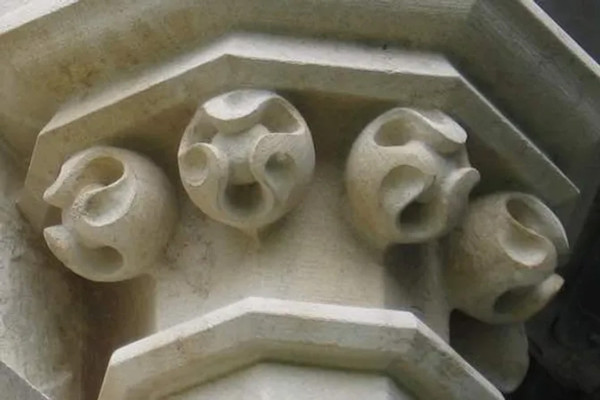
The picture on the right shows ball flowers at Gloucester Cathedral, and it is much easier to see the ball tucked into the petals of a flower.